Research and infrastructure / News
SynthID Bio: Google DeepMind brings provenance markers to AI-designed proteins
Provenance reaches biological design: a proof of concept for identifying AI-generated sequences and structures.
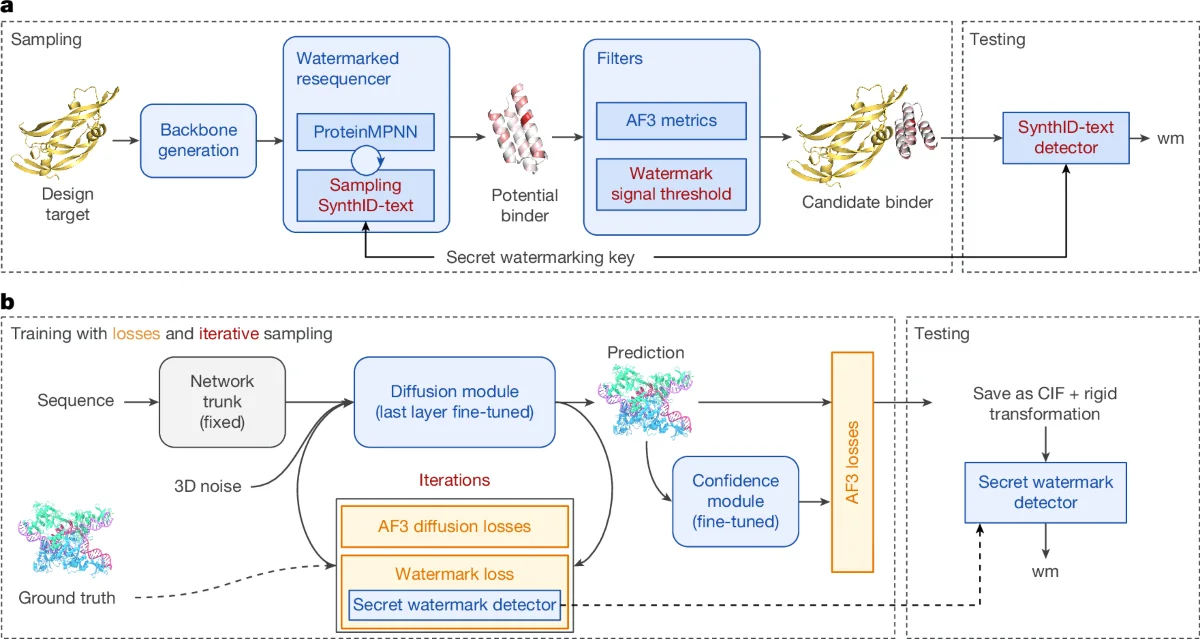
The debate about identifying AI-generated material is reaching biology. Google DeepMind has introduced SynthID Bio, research into adding provenance markers to proteins designed with these tools. [Google DeepMind]
The proposal extends the discussion beyond images and text. In research, knowing where a design comes from can help interpret it and determine which checks it needs. But a provenance marker and a safety guarantee are different things.
What the scientific paper reports
The paper by David Stutz, Alexander I. Cowen-Rivers and colleagues, published in Nature on 30 September, describes two approaches: watermarking protein sequences and predicted structures. The authors study watermark detection and preservation of function in selected designs. This bounded result does not establish the same outcome for every protein or condition. [Nature]
The distinction between an absent marker and an undetected one also matters. A provenance system cannot establish that everything it fails to identify is human-made. Its usefulness must be assessed within the specific system, including its assumptions and limits. Reporting this work therefore requires both the scientific source and the test context, without turning a technical property into a general trust label.
Identifying the origin does not validate all the content
A label may indicate that an item comes from a particular system. That alone does not prove the result is correct or suitable for every purpose. This distinction is familiar from digital documents: traceability adds context but does not replace content assessment.
Our editorial reading is that, as generative systems enter more fields, retaining information about how results were produced becomes more important.
A test with a defined scope
Reports should explain what researchers studied and its limitations. Presenting a proof of concept as a universal solution would hide questions that still need investigation. It is also useful to distinguish the press announcement from the scientific paper's evidence.
Non-specialist readers can understand the contribution without experimental details: it explores an additional layer for identifying designs. The news is not that all risks of AI-assisted biology have been solved.
A question across the sector
Who generated a result? What changed afterwards? In what context was it validated? These questions matter in science, information and digital products. SynthID Bio shows how provenance is becoming relevant in different fields.
Further validation, the technique's actual scope and how other teams can check the results will be worth following. Good reporting explains both the advance and the distance between a demonstration and established practice.
Sources and references
- Introducing SynthID Bio ↗Google DeepMind · 30 September 2026 · Primary source
- Function-preserving watermarking of AI-generated proteins ↗Nature · 30 September 2026 · Research publication
Prepared with AI assistance. Editorial policy and corrections.